Why
the Ultimate Formula 2000™
Ionic Silver
is
superior…
A Brief History of Silver as an Anti-Microbial Agent
Silver is a powerful, natural antibiotic that has been used
for thousand of years. In the early 1900’s, people
put silver dollars in the milk to keep it from spoiling
in the summertime. The ancient Greeks also knew the medical
value of silver. It was observed that those ancient families
ate from silver utensils rarely were sick and had few infections.
This knowledge passed on to kings, emperors, sultans and
their families and members of their royal courts. They
ate from silver plates, drank from silver cups, used silver
utensils and stored their food in silver containers.
As a result of this use,
silver was ever so slightly rubbed off and mixed in their
food. After a generation or two, they
received the full benefit from the silver particles, which
found their way into the body of these people. These royals
were called " Blue Bloods" because their skin had
a blue tint, due to the accumulation of minute traces of
pure metallic silver. The common red-blooded folk, however,
ate from earthenware dishes with iron utensils and frequently
were sick, while the royals enjoyed freedom from infectious
disease, often as early as from birth; the silver would accumulate
in the developing fetus via the mother during pregnancy.
The value of silver in medicine, and as a purifier has been
acknowledged for centuries. Egyptians implanted silver plates
into skulls with surgery. In Ancient Greece and Rome, people
used silver containers to keep liquids fresh. When settlers
moved across the American West, they would purify a container
of water by putting a silver dollar in it overnight.
Toward the end of the 19th century, other uses for silver
were discovered, including the use of a silver filtrate solution
put into the eyes of newborn babies to prevent blindness
due to infection. [1]
In a Science Digest article
dated March, 1978, researcher Jim Powell reports that, "Thanks to eye-opening research,
silver is emerging as a wonder of modern medicine. An antibiotic
kills perhaps a half-dozen different disease organisms, but
silver kills some 650. Resistant strains fail to develop.
Moreover, silver is virtually nontoxic." Dr. Margraf,
pioneering silver researcher, believes that, "Silver
is the best all-around germ-fighter we have." From his
extensive experiments with silver in medicine Dr. Robert
O. Becker, MD concluded in his book The Body Electric: "What
we have actually done was rediscover the fact that silver
killed bacteria, which had been known for centuries."...
However, "when antibiotics were discovered, clinical
uses for silver as an antibiotic were discarded."
Colloidal Silver's Method of Action
Certain bacteria are essential to healthy body function.
Several researchers claim colloidal silver only attacks
the unfriendly pathogens and will not harm the friendly,
but one must wonder how it can possibly differentiate.
The explanation is that the friendly bacteria are aerobic,
while unfriendly bacteria are anaerobic.
Silver does not attack bacteria
directly, but rather decomposes certain enzymes the anaerobic
bacteria, viruses, yeast, and
molds require for their respiratory processes, often referred
to as their "chemical lung". The silver acts as
a catalyst, meaning, it influences a change in the rate,
or occurrence of a reaction of one-celled organisms, but
does not enter into any chemical reaction with the body tissues,
and is not consumed in the process. It is probable that this
indirect action is also the reason bacteria cannot develop
a resistance to silver, as they do to antibiotics.
The proliferation of antibiotic-resistant strains of bacteria
is increasing at an alarming rate. A recent study involving
1300 children in 60 Toronto and North York day care centers
found that nearly 10 percent carried a pneumococcus bacteria
(A nonmotile, gram-positive bacterium (Streptococcus pneumoniae)
that is the most common cause of bacterial pneumonia, associated
with meningitis and other infectious diseases.) resistant
to penicillin, and nearly half of these bacteria were also
resistant to at least one other drug. The study led by Lee
Ford-Jones, infectious diseases specialist at The Hospital
for Sick Children, provides growing evidence of the increasing
numbers of resistant bacteria.
Bacteria or other microörganisms
cannot develop a resistance to colloidal silver, as it
destroys their ability to respire
at a very fundamental level; we would be just as incapable,
on a macro-organism level, of developing a resistance to
(and thus surviving) having our access to air (oxygen) cut
off.
In a study done, in part, by the Institute of Microbiology
in Rome, Italy, and published in Applied and Environmental
Microbiology, in December, 1992, various forms of silver
were tested for their ability to kill micro-organisms. Pure
electro-colloidal silver out performed silver nitrate, silver
chloride, and silver sulfadiazine as a broad spectrum germicide.
For all classes of bacteria, fungus, and mold samples tested,
pure electro-colloidal silver worked better, and at much
lower concentrations. They concluded that any additives reduced
the effectiveness of the pure silver ion; the silver salts
being as much as 100 times less effective. [2]
Electro-colloidal silver's effectiveness as a broad-spectrum
germicide is directly related to the number and size of the
particles. The same volume of space taken up by one silver
particle .1 microns in size, will hold about 10,000 silver
particles .001 microns in size. This reduction in particle
size not only allows for a greater distribution of the silver,
but it also greatly increases the total surface area of silver
available for interacting with the environment. These, plus
the stability of the electrical charge, are the most important
factors when considering the effectiveness of colloidal silver.
HOW DO SILVER PRODUCTS DIFFER?
Various preparations and compounds of silver are or have
been marketed over the years either for the purpose of
ingestion or for topical applications. These products have
evidenced greater or lesser degrees of efficacy, depending
on their form and composition. Many have erroneously been
labeled "colloidal silver" or "electro-colloidal
silver", so it is important to understand what the
differences are in the silver products that are on the
market.
One type commonly sold is
called "mild silver protein".
This product chemically binds microscopic particles of silver
to a protein molecule. This silver solution is usually found
in concentrations between 20-40 PPM, and its appearance may
be transparent-clear or amber.
This process was originally developed by Parke-Davis in
1935. Though the company initially felt that this preparation
held promise as an anti-microbial agent, after two years
of research it was found to be relatively ineffectual, and
so further study was abandoned. A more serious consideration
is that some companies today producing this type of solution,
perhaps in an effort to increase the solution's anti-microbial
activity, are adding iodine. Enough inorganic iodine, taken
over a period of time, will accumulate in the thyroid glands
and can become quite toxic to the body.
Another type of silver solution
is known as "silver
salts." These products can be made either chemically
or electro-chemically and usually create an ionic form of
silver that dissolves in the water. Concentrations range
between 50-500 PPM. Its appearance is transparent-clear.
The silver particles do carry a positive electrical charge,
but almost invariably, these products contain other elements
or compounds other than silver.
As described above, the silver salt solutions are often
created using a direct current (DC) device, with the silver
electrodes placed in an electrolyte solution (usually made
with sodium chloride and water). The problem with this approach
is that at least one of the compounds produced, silver chloride,
is toxic.
A third type of silver solution
is sometimes referred to as "powdered silver." This
product was developed by the Russians and is made when
a pure silver wire is rapidly
disintegrated by a high voltage electrical discharge, similar
to an old photographic flash bulb. The microscopic silver
dust is collected and either dissolved in water or added
to salves and creams for topical use. Concentrations range
from 100-500 PPM. Once the water is evaporated, it leaves
a fine silver powder and the electrical charge disappears.
In a topical cream or salve, this type of preparation will
inhibit the onset of infection in wounds, etc. due to the
presence of this silver. By the way, finely ground silver
was rubbed into the wounds of Civil War soldiers to prevent
infections.
Many of these products work, to one degree or another, as
a broad-spectrum germicide, because they contain microscopic
particles of silver. That said, it is important to understand
a number of things:
(1) Not all of these products
are "colloidal suspensions" of
silver,
(2) These products DO NOT all behave the same way in the
body or in laboratory tests,
(3) Effectiveness and dosage varies from product to product,
(4) Quality varies from product to product and from batch
to batch with the same product, and
(5) They are NOT all uniformly safe and non-toxic. As was
stated above, many contain silver chloride or even added
iodine.
The best quality colloidal
silver is produced by the True Electro-Colloidal Process,
not the chemical or grind methods.
Ultra fine particles of silver are suspended by an electrical
charge in distilled water. The force of the electrical charge
is stronger than the force of gravity, so the silver particles
remain suspended. When colloidal silver is improperly manufactured,
the silver particles can be too large and/or have no electrical
charge, causing them to fall out of suspension and reducing
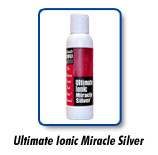
the value of the solution. Ultimate Formula 2000™ Ionic
Silver (550 PPM) is produced by a True Electro-Colloidal
Process. It contains silver particles so small that they
measure only .001 microns in size. The tiny size of the particles
combined with the proper electrical charge makes Ultimate
Formula 2000™ Ionic Silver (550 PPM) one of the best
products on the market today. The color of colloidal silver
is also important. The darker the solution, the more potent
the concentration of silver, as proven in laboratory testing.
Many companies simply do not know how to manufacture colloidal
silver properly. As a result, they are only able to produce
colloidal silver at low concentrations. Ultimate
Formula 2000™ Ionic Silver (550 PPM) does not lose its charge
and stays suspended in the solution at any concentration.
Ultimate
Formula 2000™ Ionic
Silver (550 PPM) is truly a remarkable, safe dietary supplement
that can have a profound
impact on your health and well-being.
4 Fl. Oz. Bottle
$50.00
Disclaimer:
• The above information is not intended to recommend that such
products be sold or advertised as drugs, as a diagnosis for
specific illnesses or conditions, nor as a products to relieve
or eliminate diseases or other physiological medical conditions
or complications. Clark Enterprises 2000, Inc. makes no medical
claims as to the benefits of colloidal silver dietary supplements
to improve the medical condition of individuals. Clark Enterprises
2000, Inc. does not make nor infer any medical claims about
the uses of colloidal silver dietary supplements for any
medical condition, application or situation.
•
Ultimate Ionic Miracle Silver™ is sold only as a vitamin
(dietary) supplement in the United States under the U.S.A.
Federal Food and Drug Administration’s Dietary and
Supplement Health Education Act (D.S.H.E.A.) and is not sold,
nor intended to be used or sold, as prescription pharmaceuticals
nor as an over-the-counter drugs. Clark Enterprises 2000,
Inc. does not endorse the use of Ultimate Ionic Miracle Silver™ for
medical or other purposes other than as dietary supplements
under D.S.H.E.A.
• Clark Enterprises 2000, Inc. recommends that individuals
discuss all medical interests, diagnostic, or physiological
concerns with a qualified physician or health practitioner
prior to purchasing and taking any dietary supplement.
REFERENCES:
1. Dr. Harry Margraf, "The Story of Silver in Medicine";
Gold & Silver Newsletter, September 1974
2. Appl. Environ. Microbiol., Dec 1992, 3834-3836, Vol 58, No. 12 Copyright © 1992, American Society for Microbiology
(see abstract below):
Electrochemical
Ag+ for preservative use
N Simonetti, G Simonetti, F Bougnol
and M Scalzo Istituto di Microbiologia, Facolta di Farmacia, Universita La Sapienza, Rome, Italy. 6/19/03